
Most of life feels ordinary.
We wake up, get ready, go to work, run errands, make dinner, scroll our phones, go to bed—and do it all again tomorrow. The rhythm of responsibility can flatten our vision, leaving everything feeling routine and unremarkable.
But now and then, something breaks through.
Maybe it’s stepping outside at night and catching a sky full of stars, suddenly aware of how small you are and how vast the universe must be. Maybe it’s noticing a stranger’s face and realizing that this person carries an entire lifetime of memories, relationships, griefs, and joys—just like you. For a moment, the world feels deeper. Holier. Bigger than you thought.
Those are moments of wonder.
And for many of us, they’ve become rare.
Faith was never meant to feel small or mechanical. It was never meant to be reduced to information or routine. The Christian life is meant to awaken us—to help us see the world as blazing with the presence of God. The goal isn’t simply learning more about God; it’s learning to recognize God.
To become people who notice.
To become people who look up.
Psalm 8 captures this posture beautifully:
“When I look up at your skies, at what your fingers made—
the moon and the stars that you set firmly in place
what are human beings that you think about them. . .?”
That’s the language of wonder. The psalmist doesn’t start with analysis. He starts with awe. He looks up, and everything changes.
He holds two truths together that seem impossible to reconcile:
First: God is vast. God is beyond the highest heavens, ancient and eternal, the architect of galaxies and oceans and stars. Creation itself barely contains His glory.
Second: God is personal. This same God is mindful of you. God knows you. God cares for you. God has entrusted you with mission and meaning.
The One who shaped the universe also pays attention to your life.
If you really sit with that, it’s staggering. And yet we miss it all the time—not because God isn’t there—but because we aren’t looking.
We spend much of our lives looking down. Down at our schedules. Down at our problems. Down at our screens. Down at the steady stream of news, notifications, and opinions that slowly shrink our world to the size of our own anxieties.
Technology isn’t evil, but it can quietly train us to stop noticing what’s right in front of us. We scroll past sunsets. We ignore neighbors. We consume endless commentary about the world while forgetting to actually see it. Instead of wonder, we inherit cynicism. Instead of neighbors, we see enemies. Instead of mystery, we see noise.
But what if reality is richer than the version we’re being fed?
What if God is present in every ordinary moment, waiting for us to lift our heads?
What if every conversation, every breath, every passing interaction is more sacred than we realize?
Jesus constantly pointed people back to this kind of vision. He said, “You are the salt of the earth.” Salt seems ordinary—just another item on the table. But even something as simple as salt holds hidden wonder.
Salt is made from two dangerous elements. On their own, they’re harmful. Combined, they become something essential for life. It’s a small picture of what God does with us: Left to ourselves, we can be reactive, volatile, even destructive. But in God’s hands, we are transformed into something life-giving. Something that preserves and heals.
The God who can turn something dangerous into something sustaining—what could He do with you? What could He do with your neighbor? What could He do with someone you’ve written off?
When we look up, we begin to see possibility where we once saw nothing. We start to recognize that God is always at work—shaping, forming, redeeming.
And often the difference between missing it and joining it is simply attention.
Wonder is not naïveté. It’s not pretending life is easy or that pain doesn’t exist. It’s choosing to believe that God is active even in the ordinary. It’s training our eyes to notice grace breaking through the mundane.
The psalmist didn’t discover God by escaping daily life. He found God by paying attention to the sky above him.
Wonder begins with something as simple as lifting your head.
Looking up at the stars.
Looking into a person’s eyes.
Looking for evidence that God is already here.
Because He is.
The same God who set the moon and stars in place is present on your Tuesday afternoon. The same God who governs galaxies is working quietly in your family, your workplace, your church, your neighborhood.
He is closer than you think.
But you have to look.
So maybe the invitation isn’t to try harder, learn more, or add another task to your spiritual checklist.
Maybe it’s simply this:
Slow down.
Put the phone away.
Step outside.
Notice the people around you.
Lift your eyes.
Look up.
You might just rediscover the wonder that’s been there all along.

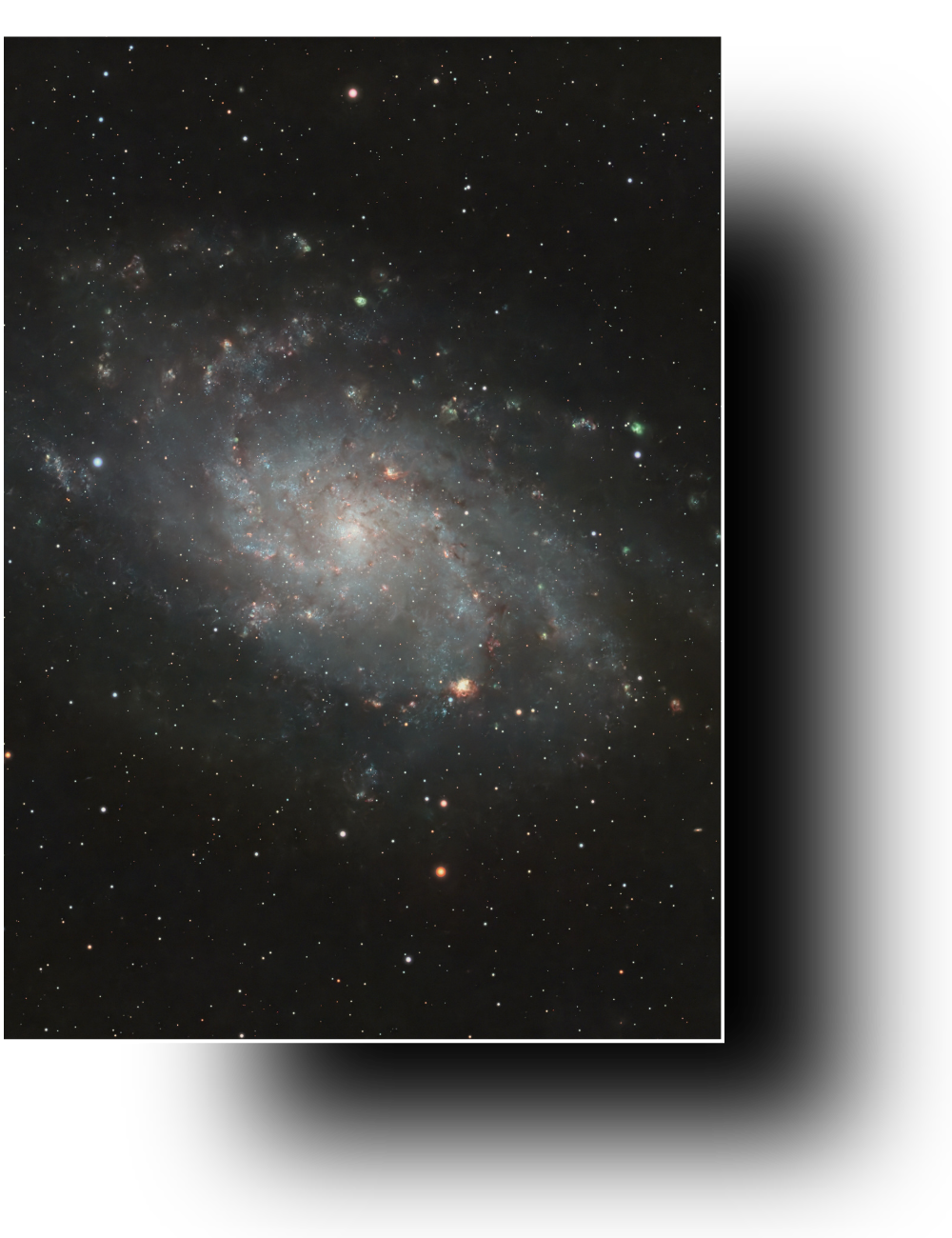
This is Messier 33, located in the Triangulum Galaxy
It is a spiral galaxy located in the constellation Triangulum and is the third-largest member of our Local Group, after Andromeda and the Milky Way.
The galaxy contains an estimated 40–60 billion stars and lies about 2.7 million light-years from Earth.
Under very dark skies, it can even be visible to the naked eye.