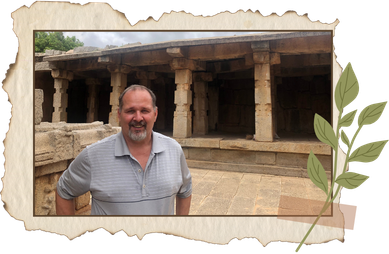

I was 17 years old when I sensed God calling me to be a missionary. I knew what a missionary was. I had read books about missions and knew of people serving around the world. Yet I had very little understanding of where God was leading me.
Fourteen years later, my wife, Sarah, our nine-month-old daughter Natalie, and I moved to India. Even then—with graduate education, ministry experience, and travel in more than forty countries—God was still refining my understanding of that calling.
In 1998, I accepted a position as pioneer Field Director for Mustard Seed and was stationed on the campus of a Christian school and mission organization in coastal Andhra Pradesh, in south India.
Even though there were people everywhere, it was a remote location. The nearest international airport required a 12-hour journey. A one-minute phone call to New Delhi cost the equivalent of one day's wage for a field laborer. At first, we had no internet connection. Later, an internet café opened 45 minutes away, but connections were painfully slow.
The campus included a Christian school with about 250 students, housing for teachers and boarding students, ministries to vulnerable children and elderly neighbors, and a computer training center. As I became friends with one of our board members, an ophthalmologist, we also began conducting rural eye camps that provided eyeglasses and cataract surgeries for people with little access to medical care.
These were worthwhile expressions of Christian mission. Yet I increasingly sensed that God had called me to something more specific: motivating, mobilizing, and equipping Christian leaders to make disciples.
After all, discipleship is the mission Jesus entrusted to His Church. It is more than teaching biblical information. Jesus calls us to help people follow Him and participate in the work He has prepared for them.
In my second year in India, I met American Christian leader Bob Moffitt from Phoenix. The way he articulated the mission of the church and the curriculum he had developed resonated deeply with the values Sarah and I had cultivated at Fuller Seminary and World Vision. We eventually moved to Hyderabad to focus on training and mentoring Christian leaders and joined Bob's ministry, Harvest Foundation. This also drew me into developing and publishing training materials.
When we moved to Tempe, Sarah went to work with Food for the Hungry, and we found a church home at Crossroads Nazarene. There I met Mike Howell, who was looking to establish a publishing office in either China or India. After discussing the possibilities, he asked, "Would you help us do this?"
My immediate response was, "No. I'm called to missions." But God would not let the idea go. Eventually, I wrote a business plan that met Mike's publishing needs in the golf industry, while allowing me to continue equipping Christian leaders in India. Twenty-one years later, that office is still serving both purposes.
In 2016, one of my staff concluded the existing youth ministry curriculum in India was inadequate, so we began creating our own. While searching for supplemental resources, we discovered animated videos from BibleProject.
I immediately realized these videos could become a powerful discipleship tool in India. I contacted The Bible Project in Portland and eventually signed an agreement to localize their videos into Telugu and Hindi. At the time, BibleProject was just beginning, with only two other localization languages. Today, it has over 5 million subscribers around the world.
In March 2020, I arrived in Hyderabad just as India entered a COVID lockdown. Within days, the global economy was collapsing, and I was asked to prepare to close our office. I sent most employees home, closed the shutters, and prayed. If God was finished with this ministry, we would accept it. But if He still had work for us, we needed Him to intervene. Within weeks, everything changed. The golf publishing business flourished, and people confined to their homes began discovering BibleProject in unprecedented numbers.
When BibleProject expanded localization into 55 languages, the global team asked how many Indian languages our team could manage. Our answer surprised even us: "Eight."
At the same time, we were field-testing our discipleship curriculum, Getting Equipped. I completed three volumes, each combining short animated videos, Bible study, discussion, and practical application. Rather than simply transmitting information, the curriculum enables participants to engage with Scripture and obey what they discover.
A few years later, conversations with the Bible Society of India led to the development of “Unveiling the Scriptures,” a 36-volume group study series covering every book of the Bible using BibleProject's book summary videos. Our Hyderabad media team is now making these resources available in ten Indian languages, beginning with Telugu.
In March 2026, we trained our first batch of Master Facilitators. By mid-July, they had already trained more than 600 disciplers. Our goal is to train over 4,000 disciplers this year. If each discipler mentors ten others, more than 40,000 Telugu-speaking believers will begin intentional discipleship within a single year.
At the same time, we are expanding into neighboring Indian states while producing Interactive Editions of the Bible in Telugu and Malayalam, featuring 175 QR codes linking directly to BibleProject videos.
Everywhere we go, churches, seminaries, and mission organizations are initially drawn to BibleProject resources. Our prayer, however, is that those resources become a doorway to something deeper—active engagement with Scripture, participatory learning, and lifelong discipleship.
For many years, Sarah and I have prayed that God would ignite a genuine discipleship movement. We are beginning to see encouraging signs that He is doing just that. Watching Him orchestrate opportunities far beyond anything we could have planned ourselves is one of our greatest joys. We are grateful simply to play a small part in what He is accomplishing.